
AI-Powered Demand Forecasting for E-commerce: How It Works
How AI-powered demand forecasting works for e-commerce, the benefits, and how to build it. Guide from Parallel Loop.
TL;DR
- AI demand forecasting ingests 12 to 24 months of sales history and produces SKU-level forecasts for the next 30 to 90 days.
- Unlike static statistical models, it retrains continuously and factors in external signals like seasonality, promotions and weather.
- McKinsey is widely cited that AI-driven forecasting can cut forecast error by 30 to 50 percent and reduce inventory by 20 to 30 percent versus traditional methods.
- The payoff: fewer stockouts, less overstock, and better cash flow. It is a build-and-integrate problem, not a plug-in.
What is AI-powered demand forecasting?
AI-powered demand forecasting uses machine learning to predict future product demand. It analyses past sales, seasonality, promotions and external factors such as weather and market trends, then generates SKU-level forecasts. Unlike traditional statistical models, it retrains itself as new data arrives, so accuracy improves over time.
The short answer
AI forecasting replaces static spreadsheets with a model that learns. It reads your history and live signals, predicts demand per SKU, and updates itself, so you order the right stock at the right time.
How AI demand forecasting works
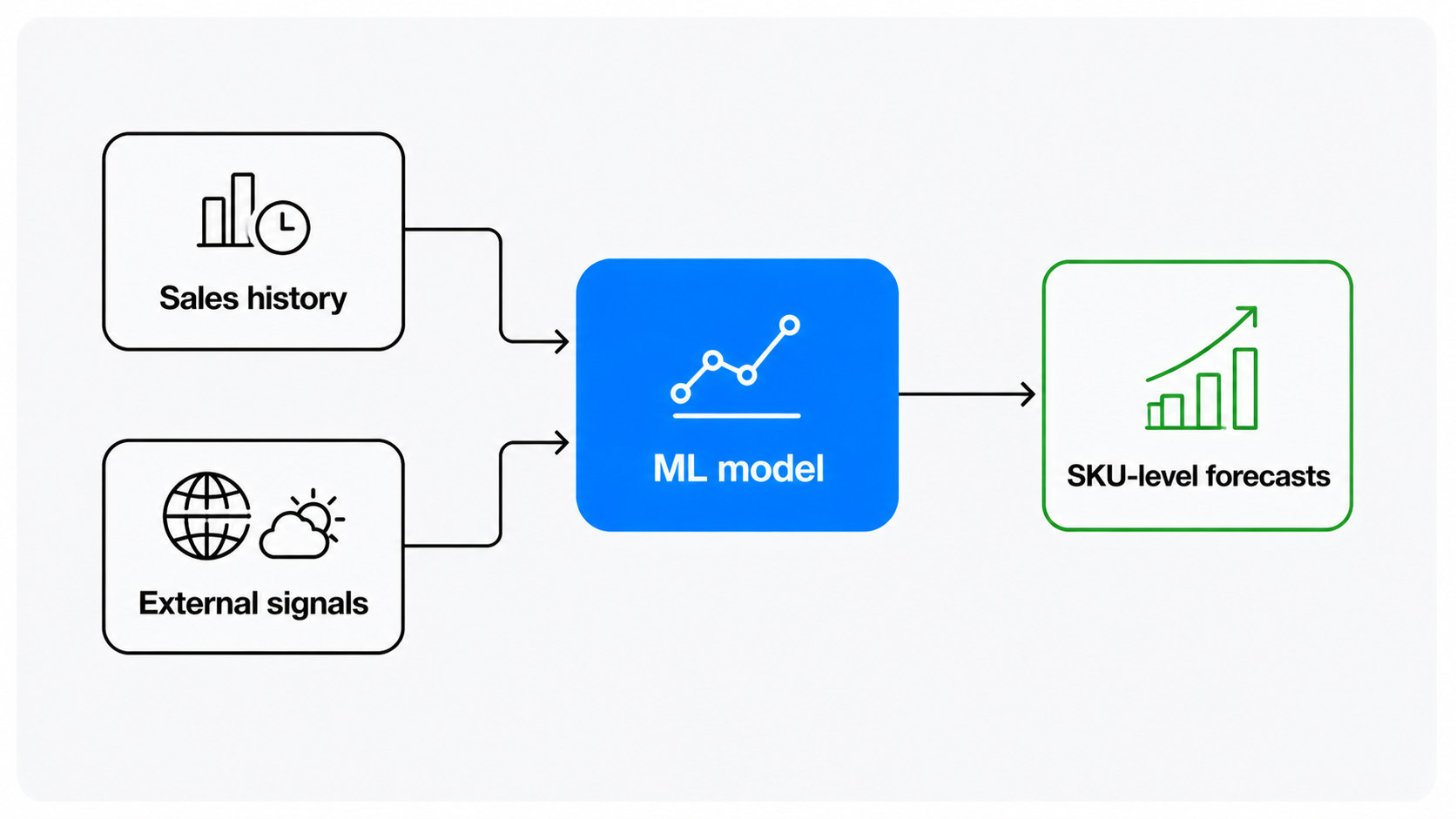
- Ingest 12 to 24 months of historical sales data.
- Identify seasonal patterns and trend signals.
- Blend in external signals: promotions, weather, market trends.
- Generate SKU-level forecasts for the next 30 to 90 days.
- Retrain continuously as new data arrives.
That continuous retraining is the key difference from traditional models, which only update when you program them to, per Shopify and Swap Commerce.
What AI demand forecasting delivers
McKinsey is widely cited that AI-driven demand forecasting can cut forecast error by 30 to 50 percent and reduce inventory levels by 20 to 30 percent versus traditional statistical methods. In practice that means fewer stockouts, less dead stock, and freed-up cash.
How to build it
AI forecasting is a build-and-integrate problem. It needs clean historical data, a trained model, and integration into your inventory and ordering systems. See machine learning supply chain software for the wider picture and our machine learning services for how we build it. Pair it with real-time inventory tracking with IoT for live inputs.
Want AI forecasting in your stack?
Book a free scoping call. We will look at your data, your SKUs and your systems, then tell you honestly whether AI forecasting will move the needle and what it takes to build. No sales pressure.
Frequently Asked Questions
How accurate is AI demand forecasting?
McKinsey is widely cited that AI-driven demand forecasting can cut forecast error by 30 to 50 percent versus traditional statistical methods and reduce inventory by 20 to 30 percent. Accuracy depends on data quality and how well the model is integrated with your systems.
How does AI demand forecasting work?
It ingests 12 to 24 months of sales history, identifies seasonal and trend patterns, blends in external signals like promotions and weather, and produces SKU-level forecasts for the next 30 to 90 days. It retrains continuously as new data arrives.
Do I need custom software for AI demand forecasting?
You need a trained model plus integration into your inventory and ordering systems. Some brands start with a packaged tool, but custom development is worth it when you have unusual SKUs, rich data, or need the forecast wired tightly into existing systems.