
Real-Time Inventory Tracking with IoT: How It Works
How IoT and RFID enable real-time inventory tracking, the components involved, and how to build it. Guide from Parallel Loop.
TL;DR
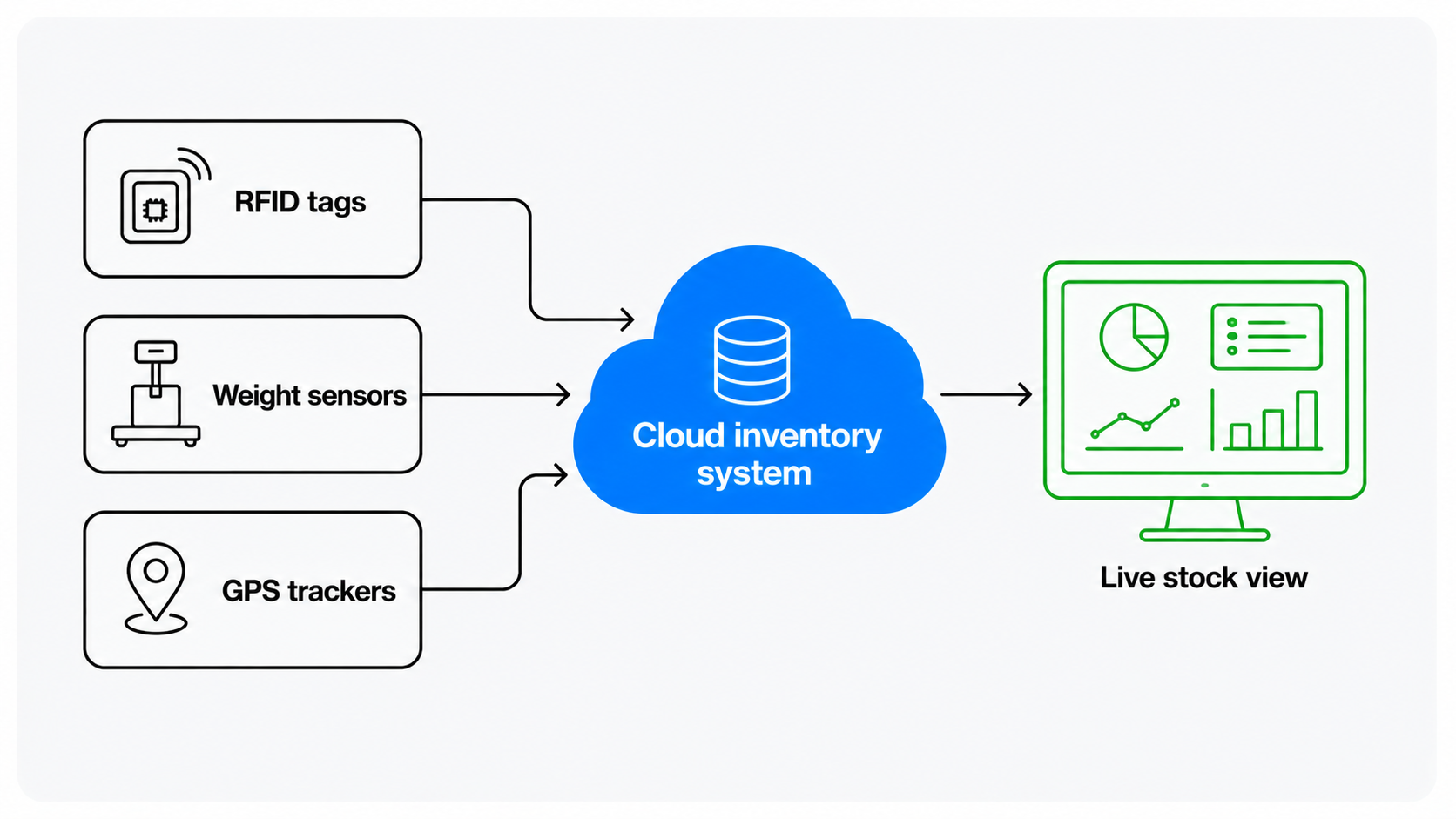
- Real-time inventory tracking uses IoT sensors, RFID tags, weight sensors and GPS to feed a cloud inventory system that updates continuously.
- RFID scans hundreds of items at once with no line-of-sight, giving instant, accurate stock counts.
- Walmart and Amazon are widely cited for using IoT and RFID to gain real-time visibility and cut stockouts.
- It is an integration problem: the value is in wiring sensor data cleanly into your inventory system.
What is real-time inventory tracking with IoT?
Real-time inventory tracking with IoT is a system that uses connected devices, RFID tags, readers, weight sensors and GPS, to monitor stock continuously and update a cloud inventory system automatically. Instead of periodic manual counts, the warehouse always knows what it holds and where, in real time.
The short answer
IoT tracking replaces manual stock counts with a live feed. Sensors and RFID report continuously, so your inventory system is always current, and stockouts and shrinkage drop.
How IoT inventory tracking works
- RFID tags store product data and communicate with readers over radio waves, scanning many items at once with no line-of-sight.
- Weight sensors on racks and floor scales detect changes and update stock automatically.
- GPS sensors give real-time location for goods in transit.
- A cloud platform ingests all of it and keeps the inventory system current.
Together these form a connected network that updates continuously, per Computools and Intuz.
Why it matters
By combining RFID with IoT sensors, Walmart achieves real-time visibility into inventory and reduces stockouts, and Amazon's smart warehouses track millions of products in real time, per widely cited case studies. The result is higher accuracy, better traceability and less lost stock.
How to build it
Real-time tracking is an integration problem. The hardware is proven; the value is in wiring sensor and RFID data cleanly into your inventory system. See inventory management software development for the system it feeds, and pair it with AI-powered demand forecasting for e-commerce to turn live data into smarter ordering. For a real-time command view across the whole operation, see supply chain control tower software.
Want real-time visibility?
Book a free scoping call. We will look at your warehouse, your hardware and your systems, then tell you what it takes to wire real-time tracking into your inventory. No sales pressure.
Frequently Asked Questions
How does IoT enable real-time inventory tracking?
IoT uses connected devices, RFID tags and readers, weight sensors and GPS, to monitor stock continuously and feed a cloud inventory system. RFID scans many items at once with no line-of-sight, so counts stay accurate in real time without manual work.
What technology is used for real-time inventory tracking?
The main components are RFID tags and readers, weight sensors on racks and scales, GPS for goods in transit, and a cloud platform that ingests the data and updates the inventory system. Machine learning is often layered on for forecasting.
Is real-time inventory tracking worth building?
It is worth it when accuracy, shrinkage or stockouts are costing you, or when you run high SKU volumes across multiple sites. The hardware is proven; the real work is integrating sensor data cleanly into your inventory system.