
Building Spellbook's Complete Legal AI Contract Review & Drafting Platform from Scratch
“Parallel Loop built our entire legal AI platform from the ground up, the LLM fine-tuning, the MS Word add-in, the dashboards. They function like a world-class internal engineering team. Absolutely outstanding execution from day one.”
Spellbook is a Legal AI Contract Review & Drafting platform designed to function as a personal legal assistant for both professionals and everyday users. The platform can scan and deeply analyze legal documents, suggest amendments with the precision of a practicing lawyer, generate fully structured contracts from simple natural-language prompts, and operate natively inside Microsoft Word through a purpose-built add-in, bringing AI-powered legal intelligence directly into the workflows where legal professionals already spend their time.
The Architectural Challenge
Parallel Loop was engaged to design and build the entire Spellbook platform from a blank slate, this was not a rescue, a migration, or a partial augmentation. It was a complete greenfield engineering effort demanding expertise across four distinct disciplines simultaneously: AI model engineering and fine-tuning, full-stack web application development, Microsoft Office extensibility, and multi-persona product architecture. The client required a legal language model that could perform at a professional standard on contract-specific tasks, not simply wrap a generic GPT API. They needed users, whether individual clients or licensed legal assistants, to be served by completely separate, role-appropriate dashboards, each with its own access model and feature set. They required the AI capabilities to be embedded directly inside Microsoft Word, where the legal profession actually drafts documents. And they needed a Stripe-powered subscription billing layer and a background job infrastructure capable of handling asynchronous document processing and inference queuing at scale. Without solving all four layers in parallel and with zero legacy code to build upon, the entire product would fail to reach market.
- Hours of manual review per contract
- Drafting clauses from memory or static templates
- No intelligent analysis of risk provisions
- Fragmented tools across Word, email, and portals
- No self-serve option for individual or SME clients
- Fine-tuned LLM on legal corpora (OpenAI + Hugging Face)
- Native MS Word add-in for inline drafting and analysis
- Natural-language contract generation in seconds
- 3 role-based dashboards (User, Legal Assistant, Admin)
- Stripe subscriptions + Agenda Jobs background pipeline
Phase 1: LLM Fine-Tuning on Legal Corpora
Our AI engineer designed and executed a complete supervised fine-tuning pipeline to transform a general-purpose base language model into a domain expert on legal documents. Using OpenAI and Hugging Face infrastructure, the training corpus was carefully curated to include real commercial contracts, service agreements, employment contracts, NDAs, and jurisdiction-specific clause libraries spanning multiple regions. The fine-tuning process involved iterative training cycles, loss monitoring, and human-evaluated output testing against standard legal prompts to measure accuracy improvements over the base model on tasks like clause identification, risk scoring, and provision generation.
This domain adaptation is the non-negotiable foundation that makes Spellbook professionally credible. A generic large language model, when asked to analyze a limitation of liability clause or generate an indemnification provision, produces plausible but legally imprecise output that no practicing attorney would trust. The fine-tuned Spellbook model, by contrast, understands the structural conventions of legal drafting, the difference between representations and warranties, the implications of “reasonable efforts” versus “best efforts”, force majeure scope variations across common law and civil law jurisdictions, with the depth required for professional deployment.
Phase 2: Microsoft Word Add-In
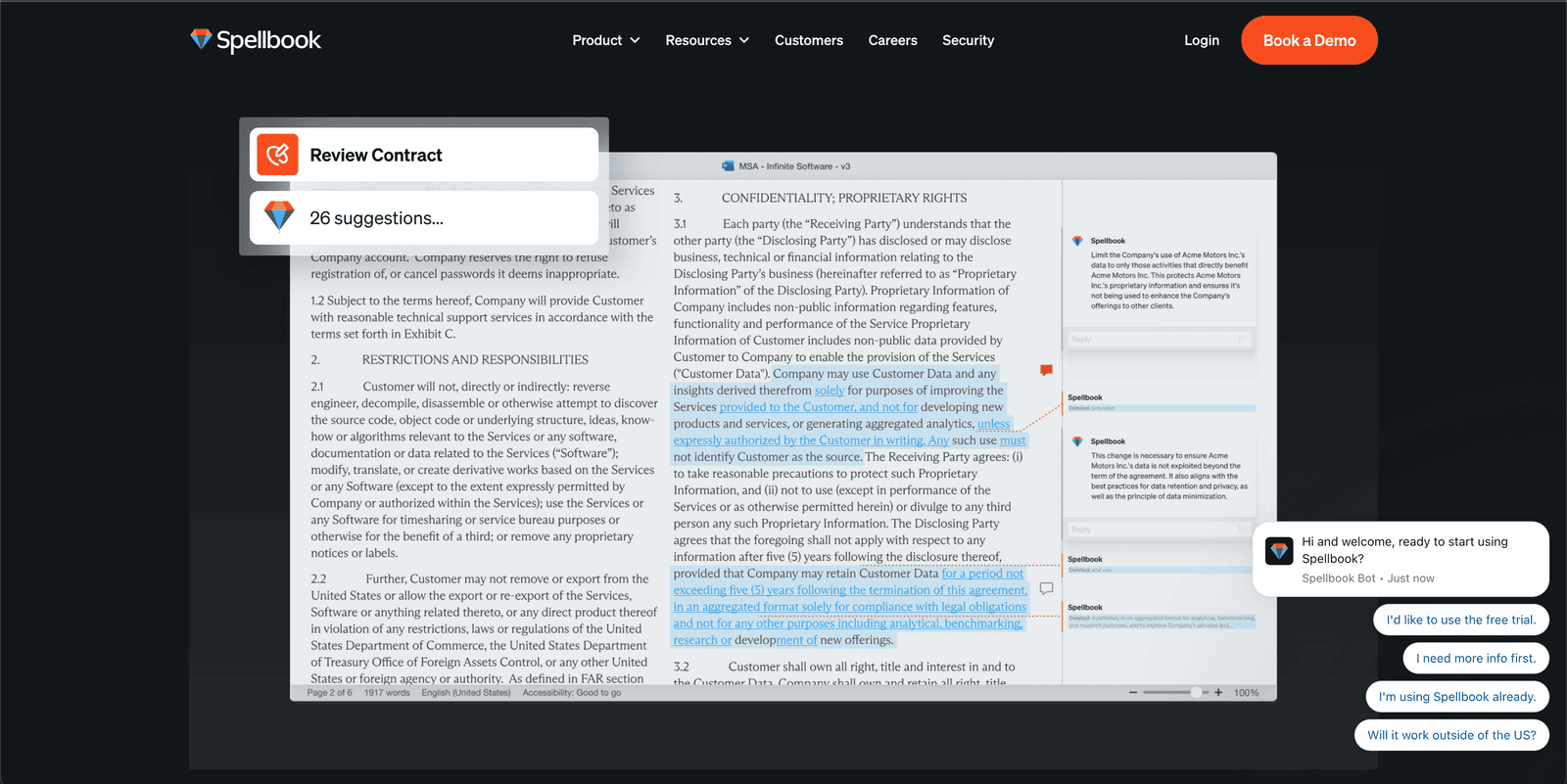
We engineered a production-grade Microsoft Word add-in using the Microsoft Office Add-in framework and JavaScript API surface, delivering the full power of the Spellbook AI directly inside the application where legal professionals draft, review, and redline contracts every day. Rather than forcing lawyers to copy text into a separate browser tool and paste results back, a workflow-breaking experience that destroys adoption, our add-in renders a fully interactive task pane inside Word that connects to the Spellbook Node.js API in real time, processing the active document contents and returning AI analysis without the user ever leaving their Word environment.
- Inline Contract Analysis: The add-in reads the entire active document, sends it to the Spellbook API, and returns a clause-by-clause risk assessment with confidence scores and rewrite suggestions rendered inside the Word task pane, color-coded by risk level so attorneys can prioritize their review instantly.
- Prompt-Driven Clause Insertion:Users type natural-language instructions directly in the task pane (e.g., “add a non-compete clause valid for 24 months across North America”) and the add-in inserts the AI-generated, legally formatted provision at the cursor position inside the Word document with a single confirmation click.
- Iterative In-Document Refinement:Lawyers can prompt further amendments conversationally, “make the termination clause less aggressive” or “add a force majeure provision covering pandemics”, and the add-in applies the change inline, maintaining full document formatting and structure without disrupting the existing draft.
Phase 3: Multi-Role Dashboard Ecosystem
We built three fully distinct, role-gated application dashboards sharing a common Node.js and Express.js backend API, with PostgreSQL as the primary relational database for structured case and user data, and MongoDB handling unstructured document storage, AI conversation history, and session state. Each dashboard was designed from scratch with its own navigation architecture, feature set, and access control model, a non-trivial engineering effort that required careful multi-tenancy design to ensure complete data isolation between user roles while maintaining a single, coherent backend service layer that all three surfaces consumed through authenticated API endpoints.
- User Dashboard:Individual clients and non-lawyers can upload legal documents to receive instant AI-powered plain-language explanations of key terms, generate fully structured contracts from natural-language prompts (e.g., “create a freelance development contract between me and a client for a 3-month project”), and iteratively refine the output by prompting clause modifications or additions until the document meets their requirements, all without needing any legal expertise.
- Legal Assistant Dashboard: Licensed legal assistants manage a full portfolio of active client cases through a structured case management interface. The dashboard surfaces AI-generated analysis summaries for each matter, flags high-risk provisions across open contracts, and provides tools to prepare and deliver structured legal insights to clients within seconds rather than the hours a manual review would require, dramatically increasing the number of matters a single legal assistant can handle concurrently.
- Admin Dashboard: Platform administrators have a complete operational command center to manage all registered users, monitor platform-wide engagement analytics, view and track inbound leads from the marketing funnel, and directly outreach prospects with built-in messaging tools, functioning as a combined CRM and operations console for the platform operator, eliminating the need for a separate sales tool.
Quantified Platform Outcomes
The complete Spellbook platform was delivered end-to-end from zero, AI model, MS Word add-in, three production dashboards, Stripe subscription billing, and the background job infrastructure, by a focused dedicated pod of four engineers operating as a cohesive internal product team. Our AI and machine learning engineering and custom software development approach ensured every architectural decision was made with long-term scalability and maintainability in mind, not just initial delivery speed.
| Performance Metric | Industry Status Quo | Spellbook (Parallel Loop Build) |
| Contract Generation Speed | Hours of manual drafting | Seconds via natural-language prompt |
| Legal Document Understanding | Manual counsel review only | AI-powered, fine-tuned on legal corpora |
| MS Word Integration | No AI tooling inside Word | Full add-in: analyze, draft, append inline |
| Platform Role Coverage | Single-audience tools only | 3 role-based dashboards (User, Legal Asst, Admin) |
| Admin Lead Management | Separate CRM required | Built-in outreach and user management panel |
Technical Deep-Dive: Frequently Asked Questions
How did Parallel Loop fine-tune the LLM on legal documents for Spellbook?
Our AI engineer built a custom supervised fine-tuning pipeline using OpenAI and Hugging Face, training on a curated corpus of legal contracts, commercial agreements, and jurisdiction-specific clause libraries. The training process included iterative cycles with loss monitoring and human-evaluated output testing against standard legal prompts. This domain adaptation allows Spellbook to produce accurate, legally relevant suggestions that outperform generic GPT responses on contract-specific tasks, understanding indemnification, liability limitation, and governing-law provisions with professional-grade precision.
How does the Spellbook Microsoft Word add-in integrate with a lawyer's existing workflow?
We developed the MS Word add-in using the Microsoft Office Add-in framework and JavaScript API. Once installed, legal professionals interact with a task pane rendered directly inside Word that connects to the Spellbook Node.js API in real time. The add-in reads the active document, returns clause-by-clause risk assessments, and allows prompt-driven clause insertion at the cursor position, without the user ever leaving their Word environment. All AI processing is handled by the fine-tuned legal model on the backend, with results rendered in the task pane within seconds.
What is the difference between the user dashboard and the legal assistant dashboard on Spellbook?
The user dashboard serves individual clients and non-lawyers: they upload documents for plain-language AI explanations, generate contracts from natural-language prompts, and iterate on clause modifications conversationally. The legal assistant dashboard is purpose-built for licensed professionals managing a caseload, it provides a structured case portfolio view, AI-generated matter summaries, and tools to deliver rapid insights to multiple clients concurrently. Both surfaces are role-gated with strict data isolation, running on a shared Node.js and PostgreSQL backend with MongoDB handling document storage and AI conversation history.