
Supply Chain Software Development: How to Build It in 2026
How to build custom supply chain software in 2026: steps, features, cost drivers and timeline. Book a free scoping call with Parallel Loop.
TL;DR
- Building custom supply chain software means mapping your full workflow first, then choosing a modular architecture: own the business logic that gives you an edge, integrate proven third-party systems for the rest.
- Core modules: inventory, warehouse, transportation, procurement, supplier management, plus ERP, carrier and EDI integrations.
- Cost is driven by scope, integrations, data volume, AI and compliance, not by seat count. On Parallel Loop, starter supply chain builds start from $19,000, real-time visibility platforms from $32,000, TMS or WMS modules from $42,000, and custom logistics platforms from $48,000.
- A fixed-scope build with the right partner beats a fully bespoke platform you cannot maintain.
What is supply chain software development?
Supply chain software development is the process of designing and building custom digital tools that manage and optimise the flow of goods, data and money across the supply chain. It covers inventory, warehousing, transportation, procurement and supplier management, integrated into one system shaped around how a specific business actually operates.
The short answer
Map your workflow end to end, then build modularly. Own the parts that are a competitive edge and integrate proven systems for the rest. This keeps the build focused, the cost controlled, and the system maintainable.
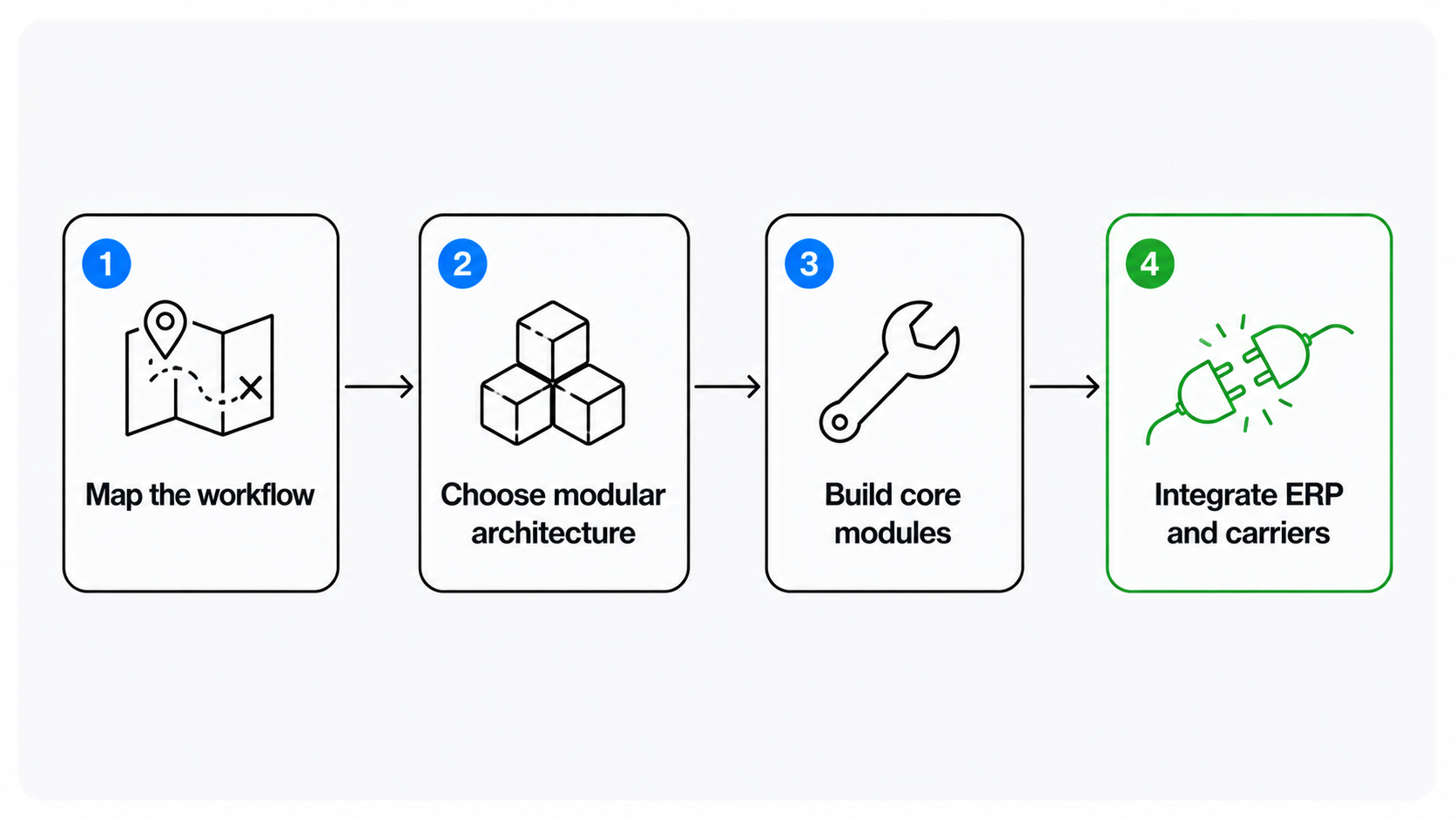
Step 1: Map your workflow before you build
Map every stage, from sourcing and production to delivery and returns. This shows how goods, data and decisions move, and it exposes the gaps software should close. Skipping this step is the most common reason builds overrun.
Step 2: Choose a modular architecture
Most operators investing in custom supply chain software in 2026 choose a modular architecture over a fully bespoke platform, per Leanware and Cleveroad. The aim is to own the business logic that creates competitive advantage while integrating proven third-party systems wherever possible. It lowers risk and speeds delivery.
Step 3: Build the core modules
- Inventory management with real-time tracking and reorder logic.
- Warehouse management for receiving, picking, packing and shipping.
- Transportation management for planning, dispatch and freight optimisation.
- Procurement and supplier management.
- Analytics and, where it pays off, AI for demand forecasting and route optimisation.
For the AI layer, see machine learning services and our explainer on machine learning supply chain software.
Step 4: Integrate ERP, carriers and EDI
Integration is where custom earns its fee. Clean, real-time links to your ERP, carrier APIs and EDI partners remove manual re-keying and give you one source of truth. Brittle point-to-point connections are the thing to avoid.
What does supply chain software development cost?
Cost is driven by scope, integrations, data volume, AI and compliance, not by seat count. On Parallel Loop, starter supply chain builds start from $19,000, real-time visibility platforms from $32,000, TMS or WMS modules from $42,000, and custom logistics platforms from $48,000. Full breakdown in our guide to supply chain software development cost, and a build-vs-buy view in custom vs off-the-shelf supply chain software.
How long does a build take?
A focused module can ship in weeks. A multi-module platform runs across several months, built iteratively in Agile cycles so you see working software early and adjust as you go.
Ready to scope your build?
Book a free scoping call. We will map your workflow, recommend a modular architecture, and give you an honest scope, cost and timeline. No obligation.
Frequently Asked Questions
How much does it cost to develop supply chain software?
On Parallel Loop, starter supply chain builds start from $19,000, real-time visibility platforms from $32,000, TMS or WMS modules from $42,000, and custom logistics platforms from $48,000. Cost depends on scope, not seats. Integrations, data volume, AI and compliance are the main drivers.
Should I build a fully custom platform or use a modular approach?
Most operators choose modular in 2026. You build and own the business logic that gives you a competitive edge and integrate proven third-party systems for everything else. It lowers cost and risk versus a fully bespoke platform.
How long does supply chain software development take?
A single focused module can ship in weeks. A full multi-module platform typically takes several months, built in Agile cycles so you get working software early and refine it with feedback.