
Warehouse Management Software: Features, Benefits and Who Needs It
What warehouse management software (WMS) does, its core features and benefits, and who needs one. Clear guide from Parallel Loop.
TL;DR
- A warehouse management system (WMS) tracks and controls warehouse operations end to end: receiving, storage, real-time stock, picking, packing and shipping.
- Core features: inventory tracking, barcode scanning, order routing, optimised picking lists, real-time visibility, analytics and shipping integration.
- Best fit: mid-to-large operations with high SKU counts, multiple warehouses or complex fulfilment.
- When a packaged WMS cannot match your process, a custom build closes the gap. See warehouse management system development.
What is warehouse management software?
Warehouse management software, or a WMS, is a system that tracks and manages end-to-end warehouse operations. It shows how goods are received and stored, keeps inventory accurate in real time, optimises picking and packing, and coordinates shipping, so a warehouse runs on data instead of memory and paper.
The short answer
A WMS turns a warehouse from guesswork into a measured, optimised operation. If you are managing high SKU counts, multiple sites or fast fulfilment, it pays for itself in accuracy and speed.
Warehouse flow
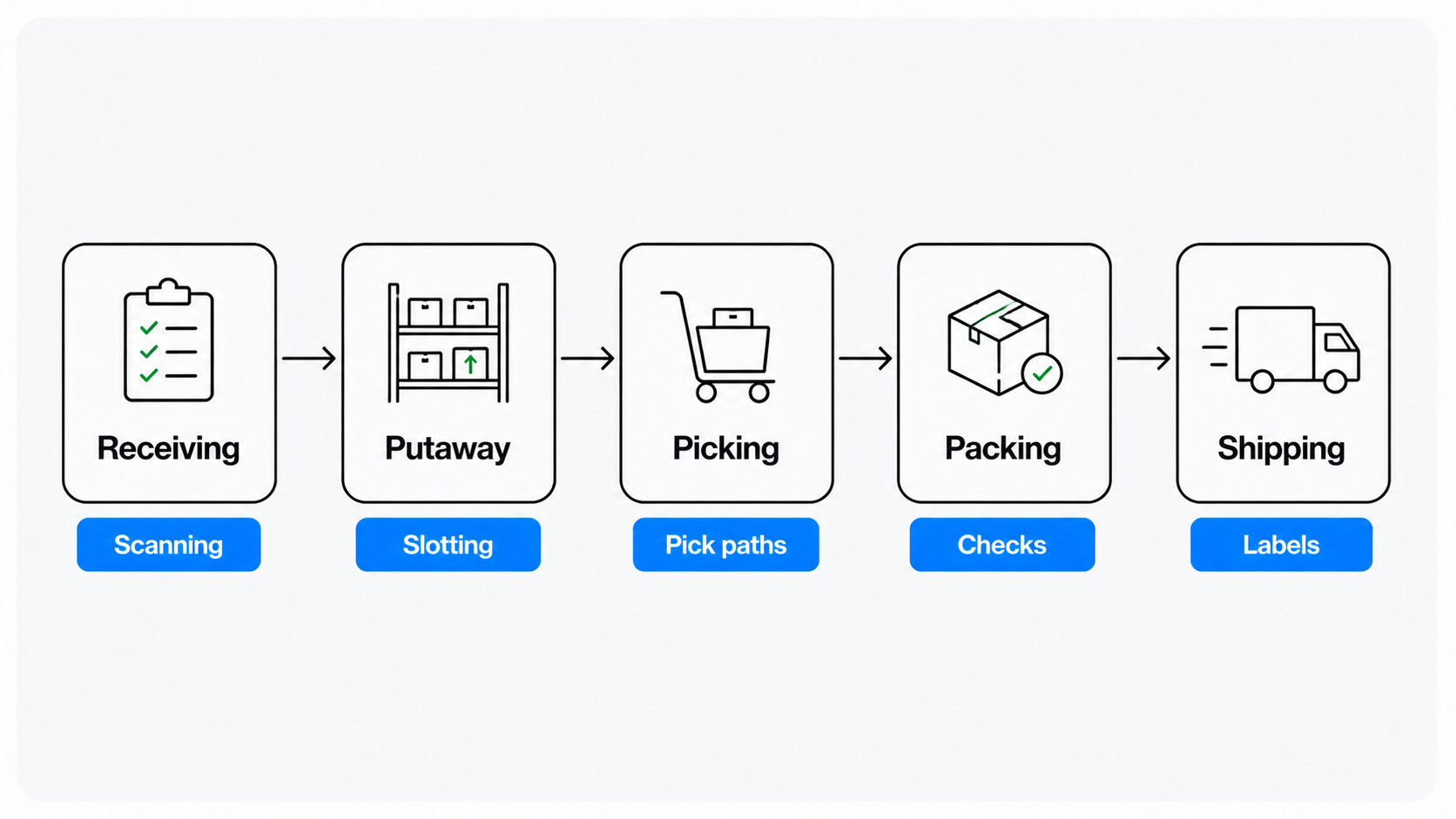
Core features of warehouse management software
- Real-time inventory tracking and stock visibility.
- Barcode and RFID scanning that removes manual data entry errors.
- Automated order routing to the right fulfilment location.
- Optimised picking lists organised by location to cut travel time.
- Warehouse analytics for throughput, accuracy and labour.
- Shipping integration and automated stock updates.
These features are the baseline, per ShipBob, Interlake Mecalux and Finale Inventory.
Benefits of a WMS
- Higher inventory accuracy and fewer stockouts.
- Lower carrying costs from optimised stock levels.
- Faster, more reliable order fulfilment.
- Better decisions from real-time data across the warehouse.
Who needs warehouse management software?
A WMS is ideal for mid-to-large operations with high SKU volumes, multiple warehouses or complex fulfilment. Teams hit by frequent stockouts, overstocking, inaccurate counts or slow fulfilment benefit the most, per ShipBob.
Off-the-shelf WMS or a custom build?
Packaged systems work when your warehouse flows are standard. When your process is unusual, or you need deep integration with an ERP, carriers or automation hardware, a custom build fits better. We cover the build side in warehouse management system development.
Outgrowing your warehouse tools?
Book a free scoping call. We will look at your SKUs, sites and fulfilment flow, and tell you whether a packaged WMS or a custom build is the right move. No sales pressure.
Frequently Asked Questions
What does warehouse management software do?
A WMS tracks and manages warehouse operations end to end: receiving and storing goods, keeping inventory accurate in real time, optimising picking and packing, and coordinating shipping. It replaces paper and spreadsheets with real-time data.
What are the core features of a WMS?
Core features include real-time inventory tracking, barcode and RFID scanning, automated order routing, optimised picking lists, warehouse analytics and shipping integration. Together they cut errors, speed up fulfilment and improve stock accuracy.
Who needs warehouse management software?
Mid-to-large operations with high SKU counts, multiple warehouses or complex fulfilment benefit most. If you face frequent stockouts, overstocking, inaccurate counts or slow order fulfilment, a WMS is usually worth it.