
Inventory Management Software Development: Features and Cost
How to build custom inventory management software: features, integrations, cost and timeline. Book a free scoping call.
TL;DR
- Custom inventory management software is built around your SKUs, warehouses and reorder logic, not a vendor's template.
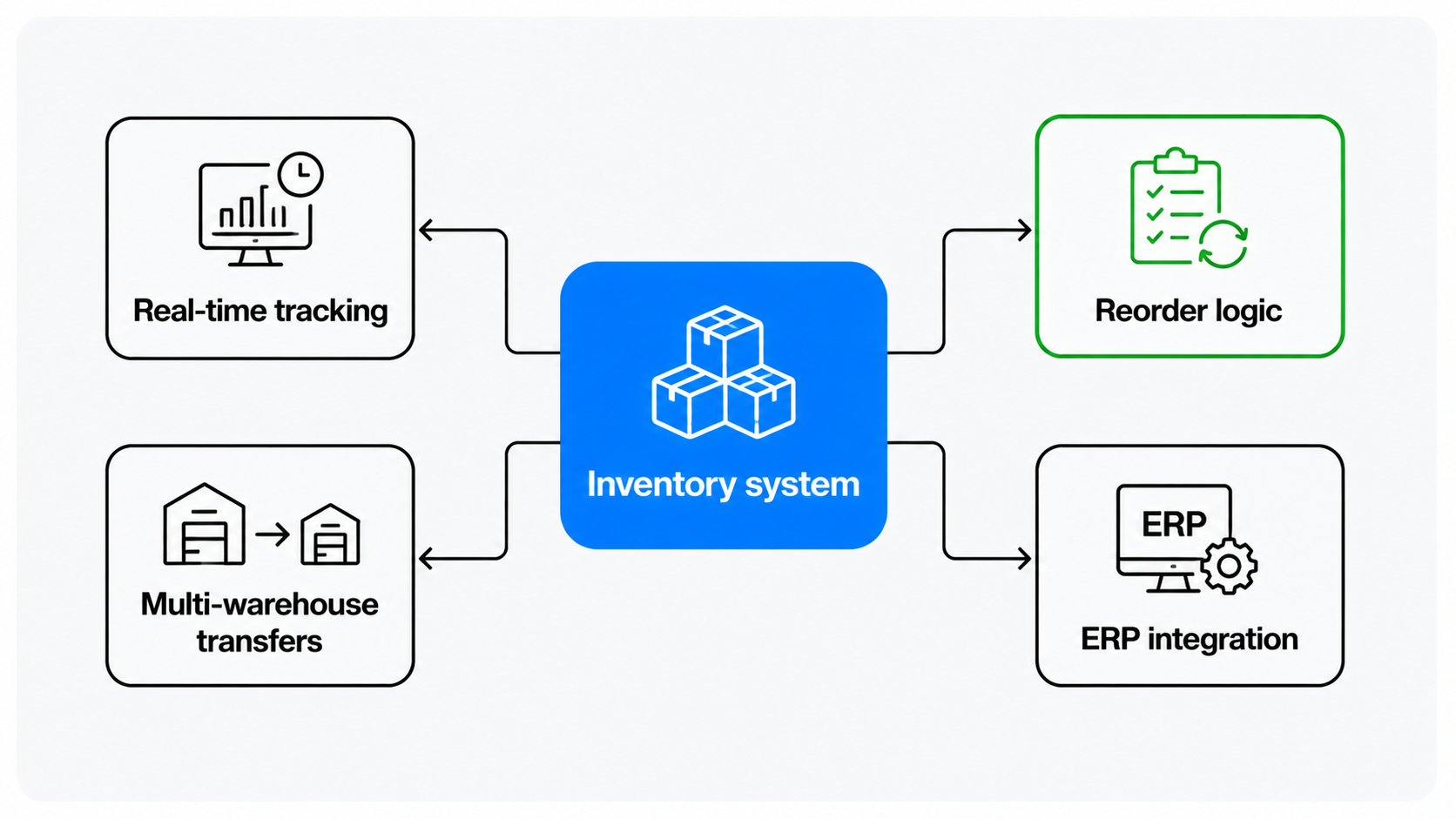
- Core features: real-time tracking, barcode and RFID, reorder points, bill of materials, multi-warehouse support and ERP or CRM integration.
- On Parallel Loop, starter supply chain builds start from $19,000, real-time visibility platforms from $32,000, TMS or WMS modules from $42,000, and custom logistics platforms from $48,000.
- Add real-time IoT tracking and AI demand forecasting when accuracy and stock planning are the bottleneck.
What is inventory management software development?
Inventory management software development is the process of building a custom system that tracks stock in real time and automates reordering across one or more locations. It is shaped around a specific business, its SKUs, its warehouses and its reorder rules, rather than forcing the business to fit a packaged tool.
The short answer
Build custom inventory software when you run multiple warehouses, complex SKUs or reorder logic that packaged tools cannot express, or when you need it wired tightly into your ERP. You get accuracy, automation and a system that scales with you.
Core features of custom inventory software
- Real-time stock tracking across locations.
- Barcode and RFID scanning for accurate counts.
- Automated reorder points and purchase triggers.
- Bill of materials for assembled or kitted products.
- Multi-warehouse support with transfers.
- ERP and CRM integration for one source of truth.
These features are the baseline for a custom build, per Itransition and ScienceSoft.
Add real-time tracking and AI when it pays off
For live visibility, add IoT and RFID feeds. See real-time inventory tracking with IoT. For smarter stock planning, layer in machine learning. See machine learning supply chain software and our machine learning services.
How much does inventory software development cost?
On Parallel Loop, starter supply chain builds start from $19,000, real-time visibility platforms from $32,000, TMS or WMS modules from $42,000, and custom logistics platforms from $48,000. Scope, number of integrations, data volume and AI move the figure. Full breakdown in supply chain software development cost.
Building an inventory system?
Book a free scoping call. We will map your SKUs, warehouses and reorder logic, then give you an honest scope, cost and timeline. No sales pressure.
Frequently Asked Questions
How much does it cost to build custom inventory management software?
On Parallel Loop, starter supply chain builds start from $19,000, real-time visibility platforms from $32,000, TMS or WMS modules from $42,000, and custom logistics platforms from $48,000. Scope, integrations, data volume and any AI layer are the main drivers.
What features should inventory management software have?
Core features are real-time stock tracking, barcode and RFID scanning, automated reorder points, bill of materials, multi-warehouse support and ERP or CRM integration. Add IoT tracking and AI forecasting when accuracy and planning are the bottleneck.
Is custom inventory software better than off-the-shelf?
Custom is better when you run multiple warehouses, complex SKUs or reorder logic packaged tools cannot express, or when you need deep ERP integration. For simple, standard stock control, an off-the-shelf tool is usually enough.