
Integrating LLMs into Production Applications: What Actually Breaks
Moving an LLM feature from demo to production: latency, cost, evaluations, guardrails, fallbacks and monitoring, plus the traps that sink most launches.
TL;DR
- A working LLM demo and a production LLM feature are different projects. The demo proves it can work once. Production means it works every time, cheaply, and fails safely.
- The five things that break launches: latency, cost, output quality, safety, and silent failures. Plan for each before you ship.
- Evaluations are the foundation. Without a test set that scores real inputs, you cannot tell whether a prompt or model change made things better or worse.
- Guardrails, fallbacks and monitoring turn an unpredictable model into a dependable feature. This is engineering work, not prompt tweaking.
- McKinsey's 2025 survey found 79% of organisations now use generative AI, yet only about 7% have scaled it enterprise-wide and roughly 5.5% report a material bottom-line impact. The gap is production discipline.
Production-ready, defined
An LLM feature is production-ready when it meets a measured quality bar on real inputs, responds within an acceptable latency and cost budget, refuses or escalates unsafe requests, degrades gracefully when the model or API fails, and is monitored so you see problems before your users report them.
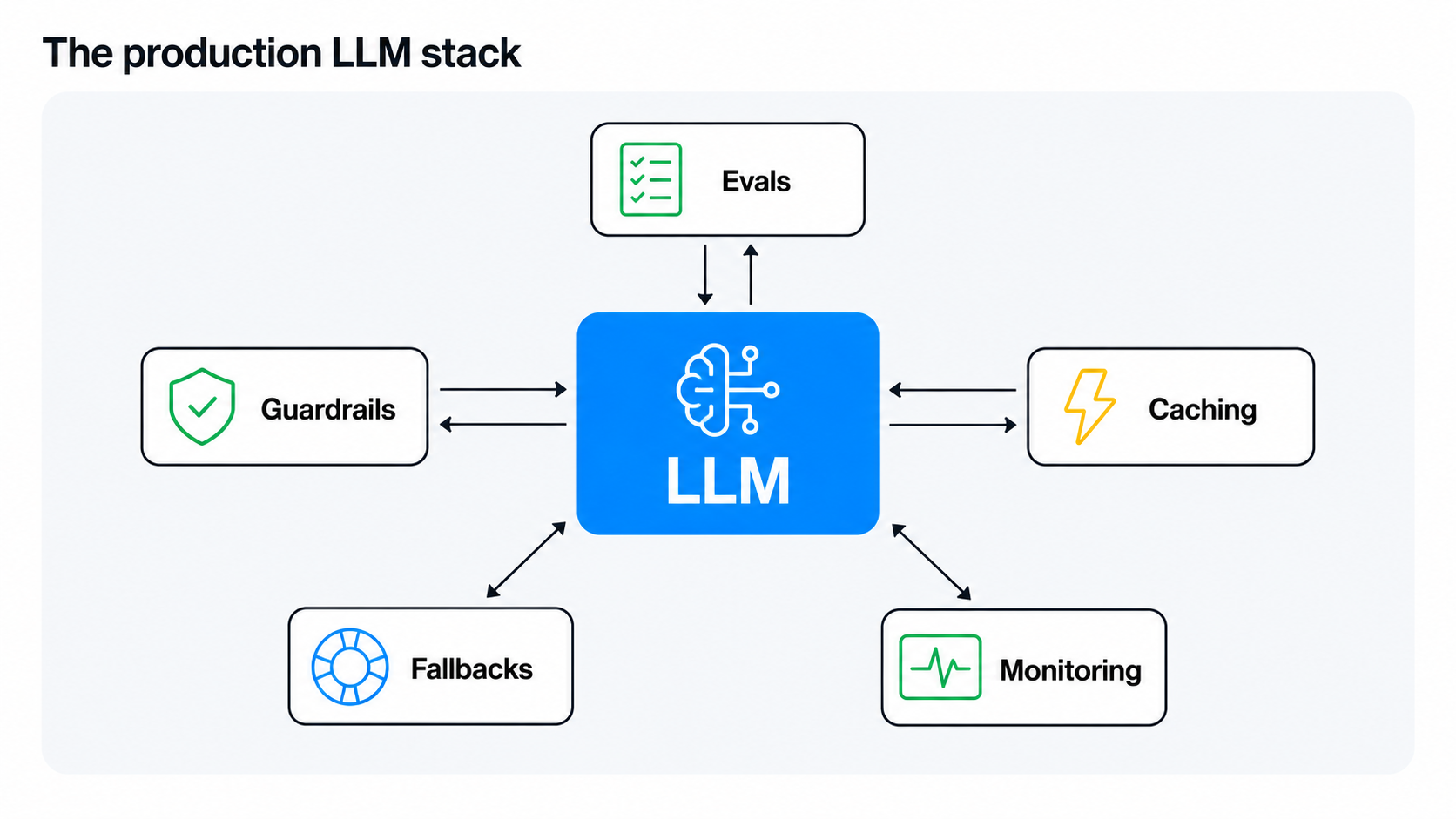
Why is a demo not the same as production?
A demo runs a happy path once, in front of a friendly audience, with a curated input. Production runs thousands of times a day on inputs you did not anticipate, under a cost budget, with real users who will paste in nonsense, hit send twice, and screenshot any mistake. The model is the same. Everything around it is the hard part.
This is the gap in the adoption numbers. McKinsey's 2025 State of AI reports that 79% of organisations use generative AI, up from 33% in 2023, but only about 7% have scaled it across the enterprise and around 5.5% see a material earnings impact. Plenty of teams can build a demo. Far fewer get it to production and keep it there.
The five things that break in production
1. Latency
LLM calls are slow compared to a database query, and a multi-step chain multiplies the wait. Users abandon slow interfaces. Stream responses so the first tokens appear fast, cache repeated queries, run independent calls in parallel, and route simple tasks to smaller, faster models instead of sending everything to the frontier model.
2. Cost
Token cost is invisible in a demo and alarming at scale. A prompt that stuffs in the whole conversation history on every turn quietly triples your bill. Trim context to what the task needs, cache where you can, and match the model to the job. Read our breakdown on API versus self-hosted AI cost for the maths on both approaches.
3. Output quality
The same prompt can return a great answer and a wrong one on inputs that look almost identical. You cannot fix what you cannot measure, so build an evaluation set: real inputs paired with acceptable outputs, scored automatically. Every prompt tweak and model swap runs against it. Without evals you are shipping on vibes and hoping. For details on evaluation frameworks, see our guide on how to evaluate an AI agent.
4. Safety and guardrails
In production the model will be asked to do things it should not: leak a system prompt, generate abuse, or act outside its remit. Validate inputs, filter outputs, constrain what the model is allowed to do, and never let raw model output trigger an irreversible action without a check. Guardrails are the seatbelt, not an optional add-on. See our guide on building agentic AI for guardrail patterns.
5. Silent failures
APIs rate-limit, models time out, and outputs drift as providers update models under you. Without monitoring, the first you hear of it is a support ticket. Log inputs, outputs, latency and cost, alert on error rates and spend spikes, and watch quality metrics over time so drift shows up on a dashboard, not in a complaint.
Fallbacks keep you online
Foundation-model APIs have outages. A production feature needs a plan for when the primary model is down or slow: retry with backoff, fail over to a second provider, serve a cached or simpler response, or degrade to a clear this is unavailable message. A feature that dies when one API blips is not production-ready.
A production integration checklist
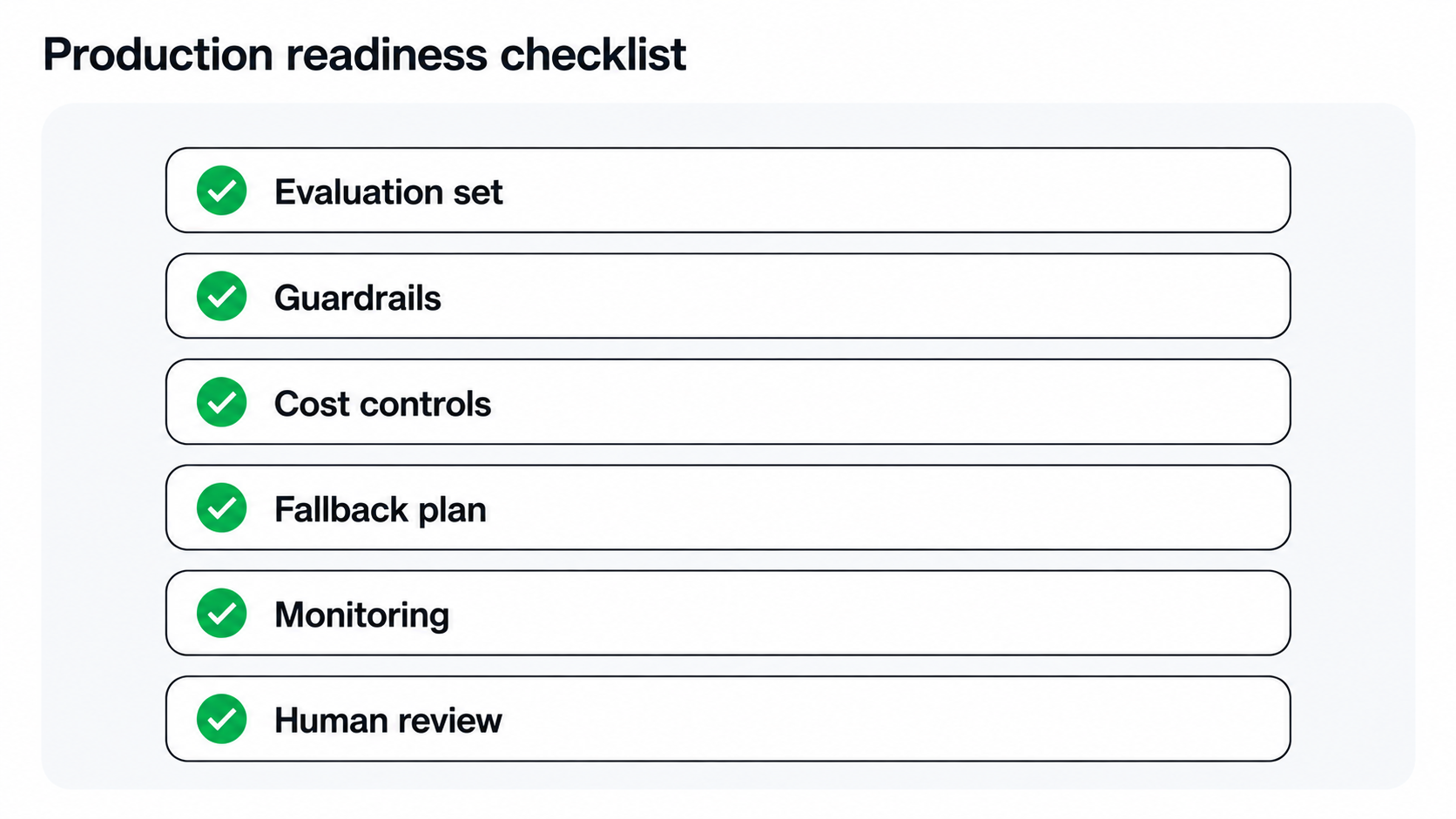
- Evaluation set built from real inputs, scored automatically, run on every change.
- Latency budget with streaming, caching and model routing to meet it.
- Cost budget with context trimming, caching and per-task model selection (refer to choosing the right AI model for model selection criteria).
- Guardrails on inputs and outputs, plus human approval for anything irreversible.
- Fallbacks: retries, a secondary provider, and graceful degradation.
- Monitoring on quality, latency, cost and error rate, with alerts.
How long does production hardening take?
Reaching a working prototype is often the fast part. Hardening it, the evals, guardrails, fallbacks and monitoring, is where the real timeline sits, and it is usually a matter of weeks for a focused feature. The teams that ship treat that work as the project, not as polish added at the end. Figures vary with scope and traffic, so treat any single estimate as illustrative until scoped.
For real-world case study context, explore our work on the MediPyxis AI hospital platform build or see our core AI development and AI agents services.
Got a demo that needs to become a product?
Parallel Loop takes LLM features from prototype to production with evaluations, guardrails and monitoring built in. Book a free scoping call and we will map the path to a feature that holds up under real traffic.
Parallel Loop pricing (USD): AI Agent Development from $10,000. MVP plus AI feature from $10,000. Custom enterprise AI builds quoted on scope.
Frequently Asked Questions
Why do LLM features fail in production?
Usually not because of the model. They fail on latency, runaway token cost, inconsistent output quality, missing safety guardrails, or silent API failures. Each is an engineering problem you plan for before launch, not after users report it.
What are LLM evaluations and why do I need them?
Evaluations are a test set of real inputs paired with acceptable outputs, scored automatically. They let you tell whether a prompt or model change improved or degraded quality. Without them you cannot measure regressions, so you are effectively shipping blind.
How do I control LLM costs in production?
Trim context to what each task needs, cache repeated queries, and route simple tasks to smaller, cheaper models instead of sending everything to a frontier model. Token cost scales with usage, so small per-call savings compound quickly at volume.
What guardrails does a production LLM feature need?
Input validation, output filtering, limits on what the model can do, and human approval before any irreversible action. The goal is that even a malicious or malformed input cannot make the feature do something harmful or expensive.
How much of an AI project is getting to production?
Most of it. McKinsey's 2025 data shows 79% of organisations use generative AI but only about 7% have scaled it enterprise-wide. Building a demo is quick; the evaluation, guardrail, fallback and monitoring work that makes it dependable is where the effort and the value sit.