
Generative AI Development Services: What They Include and When to Buy
What generative AI development services cover, the use cases they suit, how engagements are structured, and how to tell a real provider from a wrapper.
TL;DR
- Generative AI development services build products that create content or take action using large language and diffusion models: chatbots, agents, RAG systems, and AI features inside existing software.
- A real engagement covers the full stack: use-case scoping, data and retrieval, model selection, evaluation, guardrails, integration and production monitoring, not just a prompt on top of an API.
- Buy them when AI is core to a product you are building, when you need to ship fast, or when you lack in-house AI engineering, which most teams do.
- The difference between a real provider and a thin wrapper is the engineering around the model. Ask about evaluation, retrieval and failure handling.
- The market is vast. Bloomberg Intelligence projects generative AI reaching $1.3 trillion by 2032, roughly a fifth of total technology spending.
Generative AI development services, defined
Generative AI development services are the design, engineering and deployment of software built on generative models. That spans chatbots and virtual assistants, autonomous agents, retrieval-augmented generation over private data, content and code generation, and AI features embedded in existing products, together with the evaluation, guardrails and integration that make them production-ready.
What do generative AI development services include?
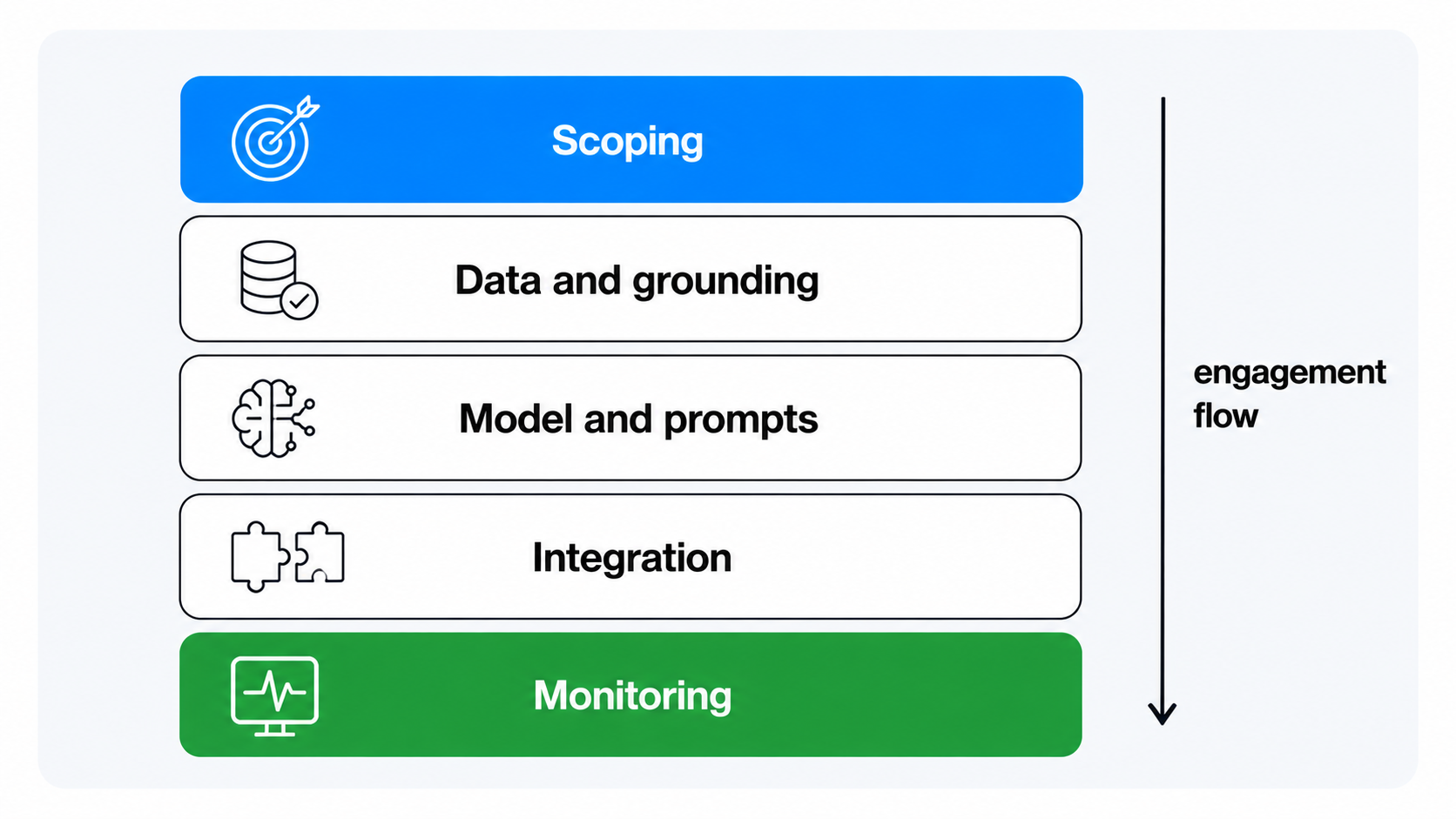
The phrase covers building, not advising. A real engagement runs from problem to production and includes each of the layers below. If a provider only offers the first and last, a prompt and an API key, you are buying a wrapper, not a product.
- Use-case scoping. Deciding what to build, whether generative AI fits, and what success looks like.
- Data and retrieval. Preparing your data and building the RAG layer so the model answers from your content (see our guide on implementing RAG over a company wiki).
- Model selection. Choosing between OpenAI, Anthropic and open-weight models per use case, not per habit.
- Evaluation. Building test sets that measure output quality on real inputs before and after launch.
- Guardrails and safety. Input validation, output filtering, and human approval for irreversible actions (see building agentic AI).
- Integration and monitoring. Wiring the feature into your product and watching quality, cost and latency in production.
What can you actually build with them?
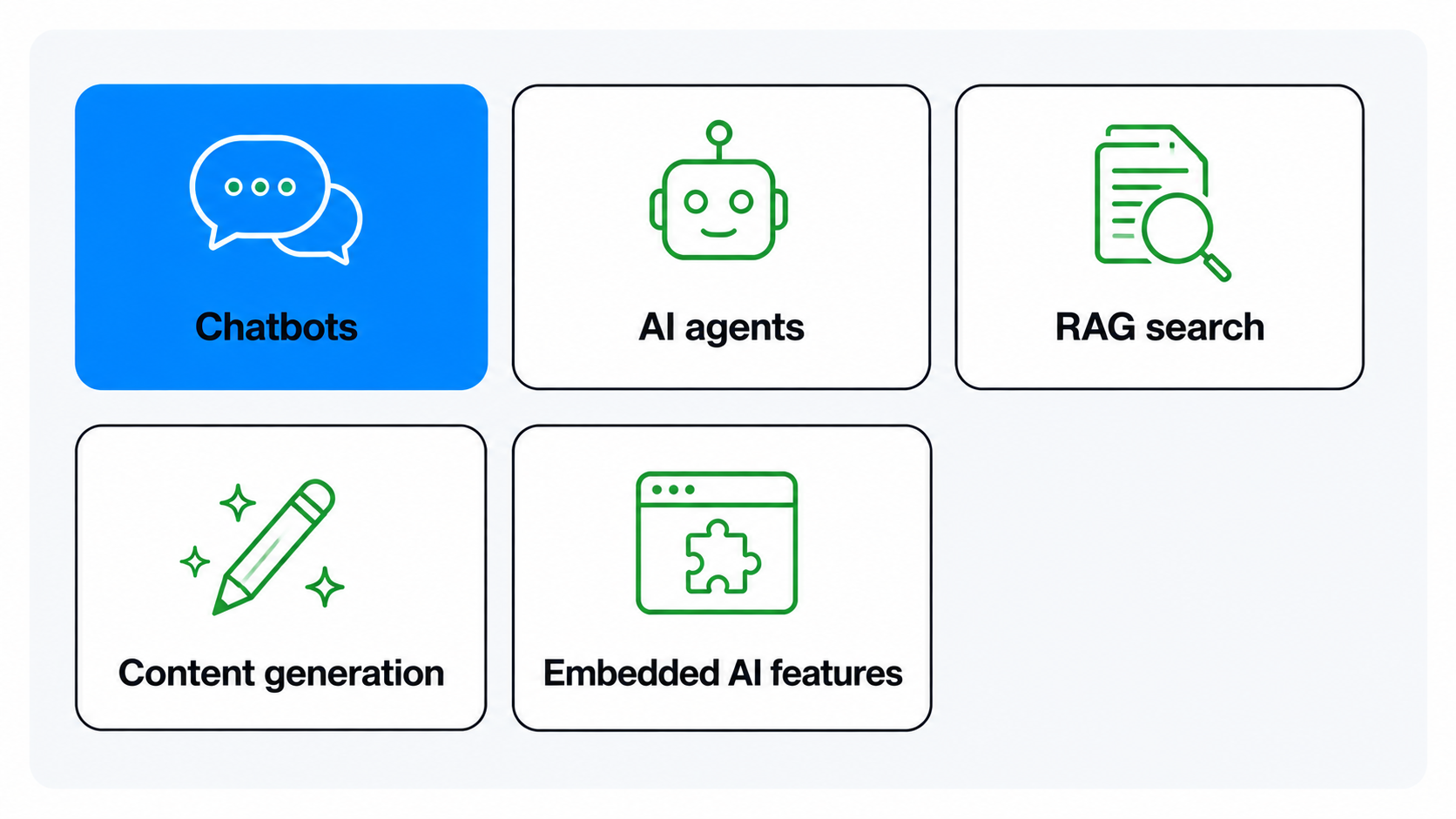
| Use case | What it does | Typical foundation |
| Chatbots and assistants | Answer questions and complete tasks in natural language | LLM plus RAG over your content |
| AI agents | Plan and take multi-step actions across tools | LLM plus orchestration and tools |
| RAG systems | Answer from your private documents with citations | Vector database plus LLM |
| Content and code generation | Draft text, images or code at scale | Generative models plus guardrails |
| Embedded AI features | Add AI inside existing software | LLM API plus your product |
When should you buy generative AI development services?
Buy them in three situations. When AI is central to a product you are building and you need it done properly. When speed matters and an experienced team will ship faster than you can hire and ramp one. And when you lack in-house AI engineers, which is most companies, because the talent is scarce and expensive. If your need is a one-off internal experiment, a smaller engagement or an advisory piece may fit better than a full build.
Services versus consulting
Consulting answers what should we do with AI and hands you a strategy. Development services build the thing. Read our breakdown on AI consulting services for details on advisory engagements. Many engagements begin with a short consulting or scoping phase to decide the what, then move into development to deliver it. Know which one you are buying, because the deliverable is different.
How is an engagement structured?
A sound engagement starts narrow. Scope one high-value use case, build it with evaluation and guardrails from the start, ship it to production, measure the outcome, then expand to the next use case. This beats a big-bang build because it proves value early and limits the blast radius if the first idea is wrong. McKinsey's 2025 data shows most organisations use generative AI but few have scaled it, and narrow, iterative delivery is how the few get there.
How to tell a real provider from a wrapper
Ask three questions. How do you evaluate output quality? How do you build retrieval over private data? How do you handle a bad output or an API outage? A real provider answers fluently, with specifics about evaluation sets, chunking, reranking, guardrails and fallbacks. A wrapper changes the subject. The engineering around the model, not the model, is what you are paying for. Pricing scales with scope, so treat any headline number as illustrative until scoped.
For context on evaluating partners, read our guide on how to choose an AI development company. For real-world implementation experience, see how we delivered the Cleon1 B2B lead enrichment platform or explore our core AI development and AI agents services.
Scoping a generative AI build?
Parallel Loop delivers generative AI development end to end: scoping, retrieval, evaluation, guardrails and production monitoring. Book a free scoping call and we will map the highest-value use case to build first.
Parallel Loop pricing (USD): AI Agent Development from $10,000. MVP plus AI feature from $10,000. Custom enterprise AI builds quoted on scope.
Frequently Asked Questions
What are generative AI development services?
They are the design and engineering of software built on generative models: chatbots, agents, RAG systems, content and code generation, and AI features inside existing products. A full service also covers scoping, data, evaluation, guardrails, integration and monitoring, not just a prompt on an API.
What can you build with generative AI development services?
Chatbots and assistants, autonomous agents that take actions, retrieval-augmented generation over your private documents, content and code generation at scale, and AI features embedded inside existing software. Each pairs a generative model with the retrieval, guardrails and integration that make it usable.
When should I buy generative AI development services?
When AI is central to a product you are building, when speed matters more than building a team from scratch, or when you lack in-house AI engineers. For a one-off experiment or a strategy question, a smaller engagement or advisory work may fit better than a full build.
What is the difference between generative AI services and AI consulting?
Consulting decides what to do with AI and hands you a strategy. Development services build the product. Many engagements start with a short scoping or consulting phase, then move into development to deliver. Confirm which you are buying, because the deliverable differs.
How do I tell a real generative AI provider from a thin wrapper?
Ask how they evaluate output quality, build retrieval over private data, and handle bad outputs or API outages. A real provider answers with specifics on evaluation sets, chunking, guardrails and fallbacks. A wrapper deflects. The engineering around the model is the product.